Skip to content

Custom web development

Websites and web apps that are fast, secure and yours.

I write the code for your website or app line by line: no bloated theme, no plugins that break with every update. The result loads fast, holds up well and is easy to understand, for your customers as much as for Google and AI engines.

  • Node.js
  • Express
  • MongoDB
  • Cloudflare
  • Vercel
  • JavaScript
  • Tailwind CSS
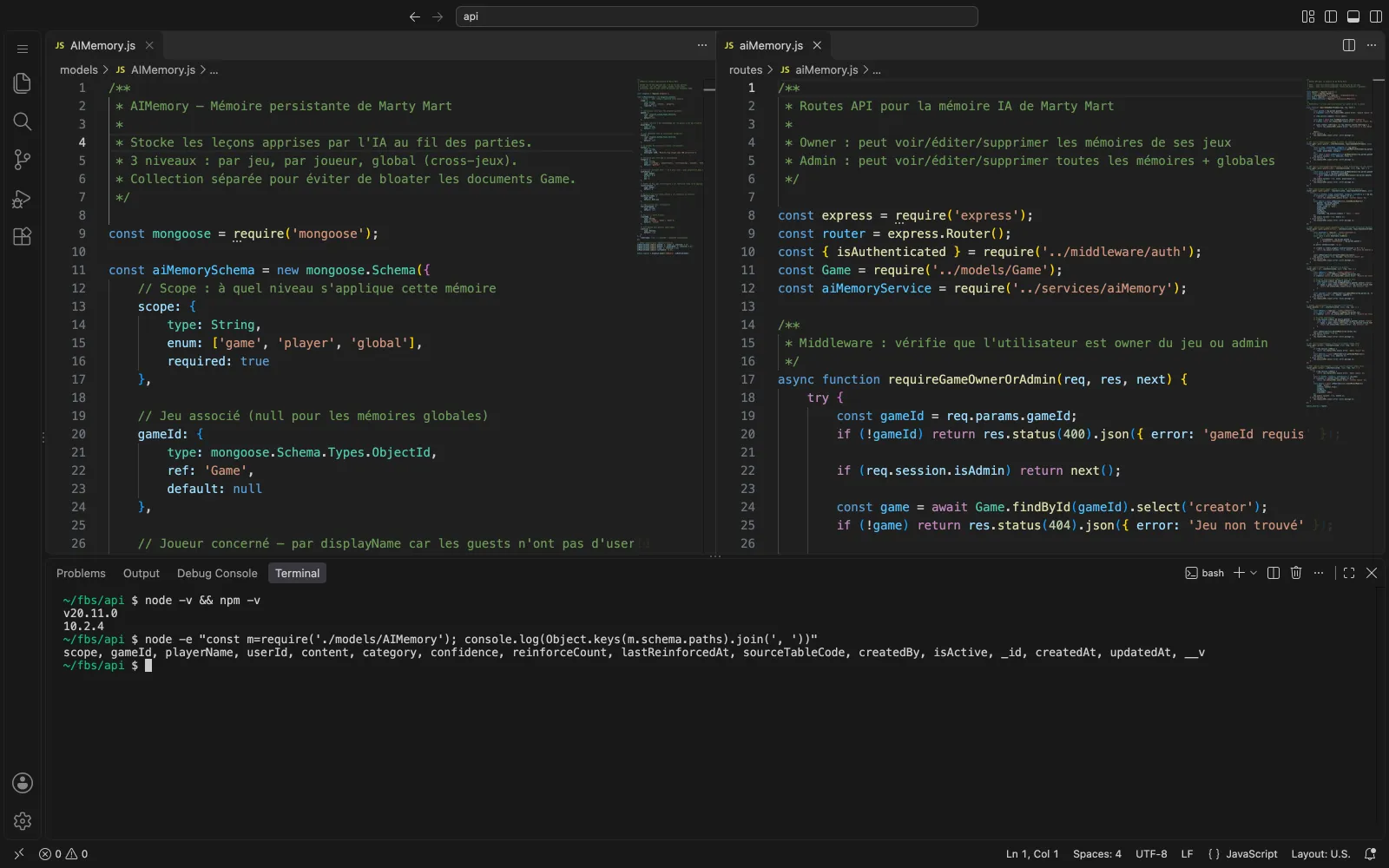
VS Code — Mongoose model and Express route
VS Code with two files side by side, a Mongoose model and an Express route, and the built-in terminal showing the Node and npm versions
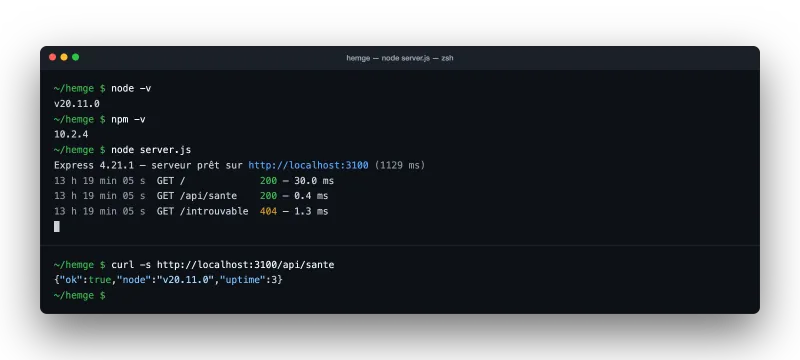
Terminal: an Express server starting on Node.js with its request log and the JSON response of a health-check route

What I build

What exactly is a custom-built website?

It's a website or app built for your business, rather than a template bent into shape. You pay for what you need, nothing more, and the code belongs to you.

Business web applications

Customer portals, internal tools, quote and order management, subscription software. This is where custom work makes the biggest difference: the tool follows the way you work, not the other way around.

  • Accounts, roles and two-factor authentication
  • Stripe payments and subscriptions
  • QuickBooks, Zoho, Google, Microsoft integrations
  • Built-in AI assistant, if needed

Examples: Muleky (hockey team management), PoPadema (purchase orders and quotes), Free Board Society (online board games).
Bilingual business websites

One page per service, a bot-protected contact form, your Google profile connected. In English and French if your customers are.

Redesigning an existing site

We start with an audit. Targeted fixes are often enough; if not, I rebuild without losing what you've earned in Google.

UX/UI

I'm a designer too: clear paths, short forms, mock-ups before code. A site people understand in three seconds converts better.

Hosting and maintenance

Domain name, DNS, certificates, security updates, backups and small changes. One person to call, no hidden fees.

Projects

From a simple website to a full application.

All projects
SaaS applicationEN · FR · ES

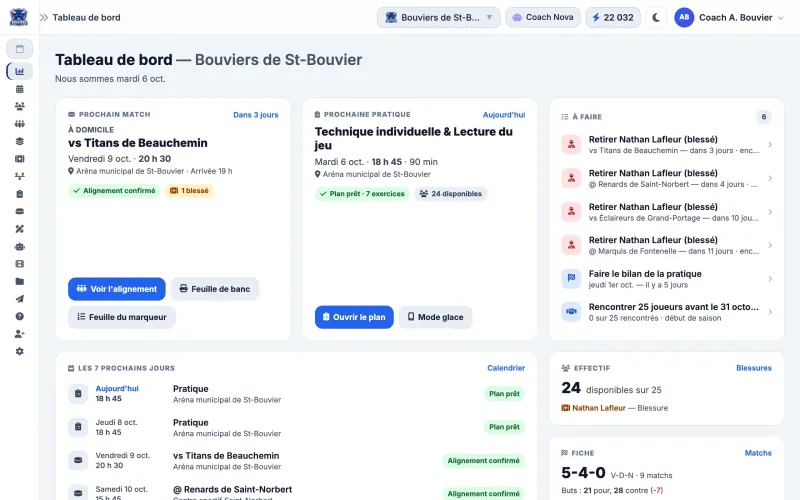
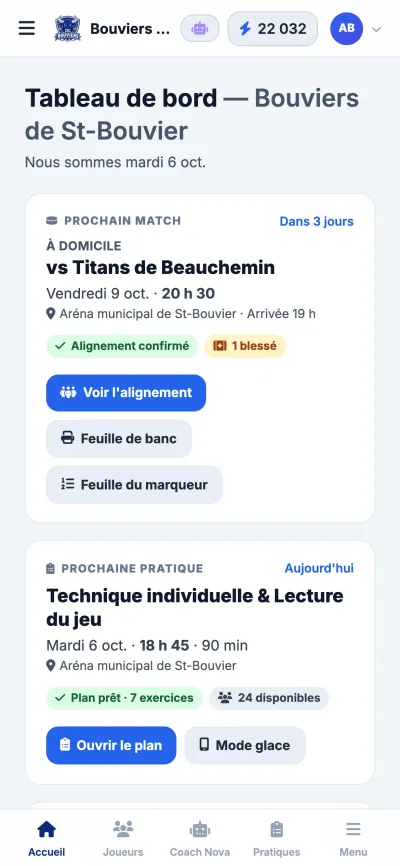
Muleky, software for hockey coaches

Practice planning, an animated drill editor, evaluations, stats, an AI assistant and Stripe billing. Node.js and MongoDB on the server, and an interface built for the laptop as much as for the phone at the boards.

  • Node.js
  • MongoDB
  • Stripe
  • Built-in AI

Fictional team and players.

Muleky — dashboard
Muleky dashboard: game of the day, next practice, to-do items and roster of the fictional team
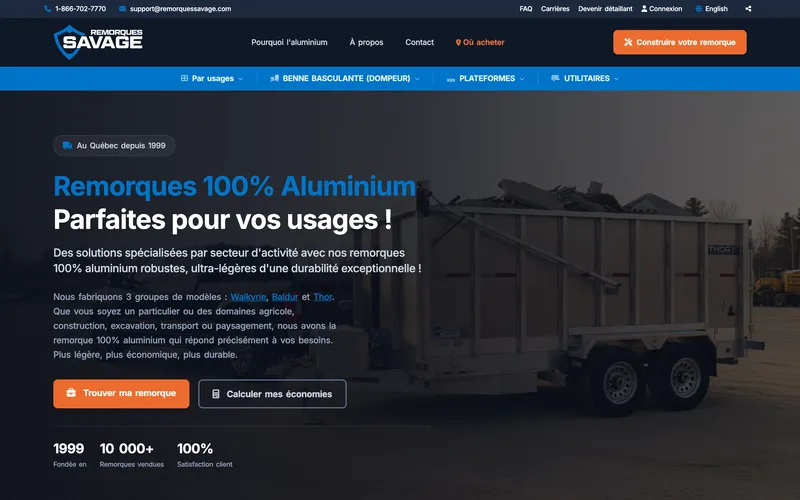
remorquessavage.com
Remorques Savage home page (French site): “100% aluminum trailers, perfect for your uses” and a “Build your trailer” button
Brand, site and back endFR · EN

Savage Trailers

One code base for two domains, French and English. Configured quotes, customer accounts with two-factor authentication, a back office for the sales team, and a daily MongoDB backup to S3.

See the project
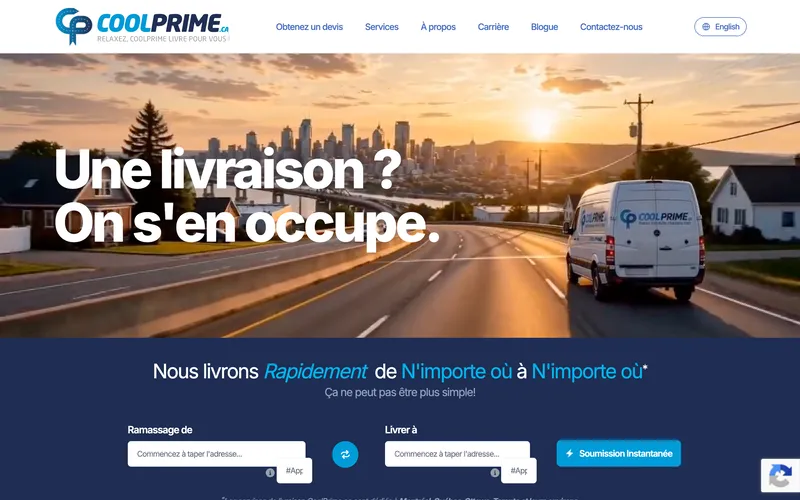
coolprime.ca
CoolPrime home page (French version): “A delivery? We've got it.” and an instant quote form
Online bookingStripe · Twilio

CoolPrime

Customers enter two addresses, get a price based on distance and traffic, confirm their phone by text message and pay online. A driver-tracking app is in development.

See the project

Technologies

The technologies I build your site with.

Proven, lightweight and widely used tools, chosen so your site stays fast and another developer could take it over if it ever came to that.

Node.js and Express

The server, the APIs, the forms and email sending. One language, JavaScript, from browser to server.

MongoDB

The database for your customers, orders or content, flexible as your business changes.

Cloudflare

DNS, content delivery network (CDN) and Turnstile, bot protection that doesn't frustrate your visitors.

Vercel

Hosting and automatic deployment with every change, with one-click rollback.

Plain JavaScript and Alpine.js

The interactivity you need without a heavy framework to download. Less code, fewer breakdowns.

Tailwind CSS

Precise, consistent design, and a stylesheet trimmed to what your site actually uses.

How do you secure a small-business website?

With simple measures applied from day one, rather than a patch after an incident. Here's what I put in place by default.

  • Two-factor authentication for admin accounts.
  • Automatic database backups, tested.
  • Rate limiting to slow down attacks and abuse.
  • Bot-protected forms (Cloudflare Turnstile or reCAPTCHA).
  • Quebec's Law 25: cookie consent banner, privacy policy, collecting only what's needed.

Why does website speed matter so much?

Because visitors don't wait, and Google measures the real experience of your pages. I optimize the three signals it watches, the Core Web Vitals.

LCP
How fast the main content appears.
INP
How quickly the page reacts to a click or tap.
CLS
Stability: nothing jumps around while loading.

How: properly sized WebP images, lazy loading, light fonts, minimal CSS, almost no third-party JavaScript, and delivery from a global network.

Google and AI engines

How do you get found on Google and in AI answers?

With a fast, clear, well-structured site that answers your customers' questions precisely, and the same information everywhere on the web. Nobody can guarantee a position in Google or in ChatGPT; I'm wary of anyone who promises one.

GEO (Generative Engine Optimization) doesn't replace classic SEO: it extends it. Google says so itself: no special optimization is needed for its AI Overviews, the basics are enough. That's exactly my territory: performance and clarity.

52%

of Quebec internet users had already used generative AI by fall 2025, up from 33% a year earlier.

NETendances 2025, Université Laval

8% vs. 15%

Click rate on a link when Google shows an AI summary, compared with a page without one.

Pew Research Center, 2025 (United States)

What I actually do

  • One page per service, saying what you do, for whom and in which region.
  • A real FAQ, built from the questions customers ask you on the phone.
  • Structured data (schema.org) so search engines understand who you are.
  • Your Google Business Profile connected and consistent with the site.
  • AI crawlers aren't blocked by mistake, and the sitemap is up to date.
  • Fast, accessible pages that read well on a phone.

Already have a site? I start with an audit: speed, structure, content, structured data, crawler access. You get a prioritized list of fixes.

Custom or platform?

Why not WordPress or Wix?

They're good tools for some projects. But for a business that wants a fast, secure website it truly owns, custom often turns out simpler in the long run: no plugins to babysit, no subscription that locks you in, no theme slowing everything down.

Tight budget? Small-business website packages A simple, effective showcase site at a fixed price, for freelancers and very small businesses. Same code quality, smaller scope. See the packages

How it works

How does a custom website project unfold?

  1. 01

    Discovery

    Your goals, your customers, their usual questions, your current tools.

  2. 02

    Structure and mock-up

    The page plan and a mock-up you approve before any code.

  3. 03

    Development

    The code, the integrations, the content in English and French.

  4. 04

    Launch

    Testing on phone and desktop, redirects, Search Console, backups.

  5. 05

    Follow-up

    Maintenance, small improvements and advice, at your business's pace.

Common questions

Web development: your questions.

And for anything AI-related, the full FAQ answers the questions small-business owners ask.

AI FAQ for SMBs
How much does a custom website cost?

It mostly depends on the number of pages, the features (forms, accounts, payments, integrations) and the content to produce. A showcase site and a business app aren't in the same category. I'll send you a detailed quote after a first conversation; for a small budget, the small-business packages have fixed prices. See also how much a website costs.

Will I be able to edit my site myself?

That depends on your needs. For a site that rarely changes, I handle updates and you have nothing to learn. If you publish often (news, products, job postings), I set up a simple admin interface for that content.

Do I need a new website to show up in ChatGPT?

Not necessarily. I always start with an audit: speed, structure, content, structured data and crawler access. Targeted fixes are often enough. A rebuild makes sense when the site is slow, hard to update or vague about what you offer.

Can my site take payments online?

Yes. For bookings, subscriptions or a small catalogue, I integrate Stripe directly into your site, as in Muleky. Payments are processed by Stripe: no card numbers pass through your server.

Who owns my website's code?

You do. The code is documented and hosted on established services; if you ever change providers, another developer can pick it up.

Related services